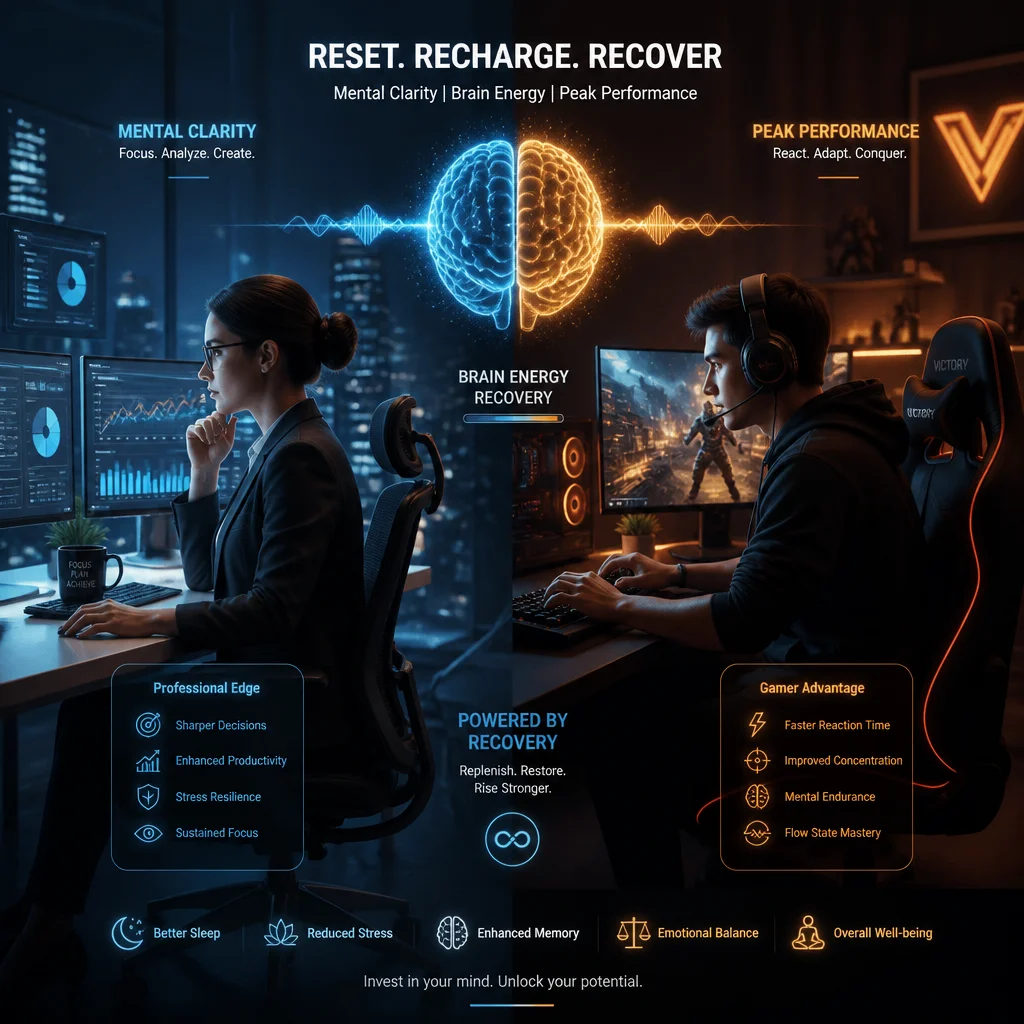
Gamers and digital professionals share a unique, invisible occupational hazard. They spend their prime working and leisure hours inside meticulously engineered digital interfaces designed to hijack attention. In doing so, they frequently mistake the resulting exhaustion for ordinary physical tiredness. Cognitive fatigue is fundamentally different from simple sleepiness. It represents the gradual degradation of executive function—the brain’s capacity for strategic planning, priority management, impulse inhibition, and working memory retention. This insidious form of mental depletion sets in long before your eyelids feel heavy, quietly sabotaging the quality, creativity, and precision of everything you produce.
Deconstructing Cognitive Fatigue: What Really Happens Inside the Brain
Although the human brain accounts for roughly two percent of total body mass, it consumes approximately twenty percent of your resting metabolic energy budget. Interestingly, that energy expenditure does not spike dramatically during intense bouts of critical thinking or complex problem-solving. This physiological reality exposes the flaw in the popular “mental battery” metaphor that many people rely on. Modern neuroscientific research into mental effort suggests that fatigue is less about running out of chemical fuel and more about the accumulation of metabolic waste products, such as adenosine, combined with a shifting neurochemical cost-benefit calculation.
When concentration starts to feel disproportionately expensive to the brain, your output drops sharply and the psychological urge to task-switch surges. This explains why you suddenly feel an overwhelming compulsion to check a notification, refresh a social media feed, or open a new browser tab after forty minutes of deep, uninterrupted analytical work. It is not a moral failing or a lack of discipline; it is an automatic biological signal indicating that the current cognitive load has crossed an unsustainable threshold.
For competitive gamers, this manifest as a fourth ranked match where mechanics falter and reaction times slow down. For software developers, UX designers, data analysts, and copywriters, it looks like rereading the exact same paragraph three consecutive times without comprehending a single word. The underlying biological mechanism is identical across both domains, which means the countermeasures must be equally systematic.
Why Digital Environments Drain Cognitive Resources Differently
Knowledge work and high-level gaming are uniquely punishing because they stack multiple cognitive loads simultaneously. You must manage the core task itself, master the complex software or game mechanics used to perform it, and constantly filter the looming possibility of unexpected interruptions. Every single open browser tab, unread chat message, and persistent notification functions as an unresolved open loop that your subconscious mind continues tracking in the background.
Cognitive psychologists refer to this phenomenon as attention residue. When you rapidly jump between a spreadsheet, a Slack channel, and a project management dashboard, a fraction of your mental bandwidth remains glued to the previous context. Rapidly switching contexts ten times does not yield ten times the output; instead, it generates a highly fragmented, low-quality simulation of a single task executed poorly.
- Unfinished mental loops: Every unanswered ping or unread email remains pinned in working memory, consuming processing power.
- High decision density: Digital interfaces force users to make dozens of micro-decisions every minute, draining executive reserves.
- Late-night visual stimulation: Exposure to blue-spectrum light delays melatonin synthesis, compounding tomorrow’s cognitive deficit.
- Sedentary stagnation: Extended hours in an office chair restrict blood circulation, triggering physical tension and mental sluggishness.
Recognizing the Early Warning Signs of Mental Exhaustion
Before cognitive fatigue fully paralyzes your productivity, your mind and body send clear physiological signals. Ignoring these indicators guarantees a crash:
- Mechanically rereading lines of text or code without absorbing or retaining the underlying logic.
- Sudden, irrational irritability triggered by minor interruptions that would normally be brushed aside.
- Noticeably slower typing speeds, erratic coordination, and a sharp spike in typographical errors.
- Physical manifestations such as a clenched jaw, shallow upper-chest breathing, and aching shoulder blades.
- Distorted judgment regarding task priority, where trivial administrative requests feel just as urgent as critical projects.
- An intense craving for cheap novelty, manifesting as compulsive scrolling, unnecessary snacking, or aimless tab-switching.
Treat these symptoms as objective telemetry data rather than personal shortcomings. The earlier you identify them, the faster and less painful the recovery process will be.
Rule One: Safeguard Your Peak Cognitive Hours
Most individuals possess a biological window of peak analytical clarity lasting two to three hours immediately following wakefulness. Tragically, this is also the exact window most people sacrifice to incoming emails, news feeds, and chat messages. Reclaiming this pristine cognitive real estate is the single highest-leverage optimization you can make.
As a strict operational rule, never open a communication application before executing your most demanding cognitive task of the day. Prepare your workspace the evening before so that morning decision-making is completely eliminated: leave the project file open, write down the core problem on a notepad, and define your immediate next step in a single, unambiguous sentence. Competitive gamers intuitively understand this principle; nobody enters a high-stakes ranked match while eating breakfast and answering text messages. Apply that exact same level of professional respect to your intellectual labor.
Optimizing the Ninety-Minute Focus Block and Eliminating Context Switching
Human physiology operates on ultradian rhythms, moving through cyclical patterns of peak alertness and trough recovery lasting roughly ninety minutes. While this cycle shouldn’t be treated as an absolute dogma, it provides a highly reliable structural framework for deep work. Organize your schedule into focused blocks of sixty to ninety minutes dedicated entirely to a single defined output, followed by a true ten-to-fifteen-minute cognitive reset.
During your break, consciously step away from all secondary screens. Before you walk away, employ a vital administrative discipline: write a concise two-line summary detailing precisely where you paused and what needs to happen next. This thirty-second habit saves you fifteen minutes of painful cognitive reloading when you return.
Context switching is the silent killer of digital productivity. Empirical studies consistently demonstrate that recovering from a task interruption takes significantly longer than the interruption itself. A thirty-second glance at a smartphone notification can trigger several minutes of hidden recovery time. To combat this, batch your communications: establish two or three dedicated, non-overlapping windows per day for handling emails and chat messages, rather than living inside those applications continuously.
Sleep: The Non-Negotiable System Reset
No productivity hack, no nootropic supplement, and no lifestyle adjustment can ever substitute for high-quality, restorative sleep. Chronic sleep deprivation steadily degrades attention span, working memory, and emotional regulation. Because the decline is gradual, individuals often feel subjectively adapted to chronic exhaustion while operating far below their true cognitive baseline.
Late-night gaming and late-night coding sessions are the primary culprits for digital professionals and gamers alike. Both activities are deeply engaging, socially reinforced, and dangerously easy to extend by “just one more round.” Establish a hard, non-negotiable stop time for screens. Dim the ambient lighting in your living space during the final hour before bed, and keep your sleeping quarters entirely free of glowing displays. If you find yourself struggling to fall asleep, get out of bed and engage in a low-stimulation activity under dim light rather than lying awake scrolling—otherwise, your brain learns to associate the bed with wakeful stress.
Nutritional Engineering: Fueling the Mind Without Blood Sugar Spikes
What feels like debilitating mental fatigue is frequently misdiagnosed dehydration or a sharp glucose crash. Heavy, carbohydrate-dense lunches trigger the classic post-lunch afternoon cognitive slump. The correct response is not to skip meals entirely, but to rebalance your intake toward high-quality proteins, healthy fats, and fibrous vegetables, keeping refined starches to a strict minimum.
Hydration requires consistent pacing rather than consuming massive quantities of water all at once. Furthermore, caffeine demands a disciplined approach. Caffeine acts as a temporary biological loan against adenosine receptors, not a true substitute for restorative rest. Consuming a second cup of coffee at four in the afternoon might buy you one hour of superficial alertness, but it invariably costs you two hours of deep sleep quality later that night—a disastrous trade-off for any knowledge worker.
Executing Micro-Breaks That Actually Restore Cognitive Reserves
Revenge scrolling through social media during a work break does not provide rest; it merely exposes your brain to a different flavor of the exact same digital load. Truly restorative micro-breaks are cost-free and take only moments to execute:
- The 20-20-20 rule: Every twenty minutes, look at an object located at least twenty feet away for twenty seconds to relax your ciliary eye muscles.
- Kinetic reset: Stand up and pace around your workspace for two minutes to rapidly restore cerebral blood flow and oxygenation.
- Physiological sighs: Take two rapid inhales through your nose followed by one prolonged, stabilizing exhale through your mouth. Repeat three times to down-regulate nervous system arousal.
- Sensory deprivation: Sit in absolute silence with your eyes closed for sixty seconds to clear auditory and visual clutter.
- Hydration and extension: Drink a glass of water while performing targeted stretches for your hip flexors, which tighten severely during prolonged sitting.
Taming the Notification Layer
Notifications are deliberate software design choices, and you retain full autonomy to redesign them. Ruthlessly disable every notification that does not originate from a human being whose immediate input is genuinely required within the hour. Remove heavy chat clients from your primary monitor setup. Utilize aggressive focus modes that permit only two or three essential contacts to break through.
When dealing with content overload, prioritize unsubscribing over manual deletion; total volume is almost always the core issue, not any single message. Gamers should apply this exact philosophy to launcher pop-ups, achievement banners, and non-essential voice chat pings. These digital interruptions shatter immersive flow states far more aggressively than most players realize, and maintaining flow is precisely what transforms gaming from an exhausting chore into a genuinely restorative pastime.
Training Attention as a Core Neuro-Skill
Attention is not a fixed, immutable trait; it is a trainable neuro-skill that expands with deliberate practice. Dedicating just ten to twenty minutes a day to focused attention exercises—where you gently guide your awareness back to an anchor whenever your mind inevitably drifts—dramatically improves your meta-awareness of distraction.
Apply this heightened awareness directly to your professional workflow. When you catch yourself automatically reaching for a new browser tab or checking your phone, pause, acknowledge the impulse by naming it silently, and return your focus to the primary task. Over the span of several weeks, the psychological gap between mental drift and course-correction shortens considerably, drastically reducing the cumulative tax of distraction.
The Physical Foundation: Movement, Light, and Ergonomics
You cannot think your way out of a purely physiological problem. Engaging in moderate cardiovascular or strength training two to three sessions per week measurably improves executive function, working memory, and overall sleep architecture. Morning sunlight exposure acts as the primary master Zeitgeber, anchoring your circadian rhythm and dictating optimal alertness cycles for the remainder of the day.
Strength training reinforces optimal spinal posture, and posture directly dictates how many hours you can sit at a desk without experiencing chronic discomfort. For gamers and desk-bound professionals, the non-negotiable physical baseline includes a morning outdoor walk, two weekly resistance training sessions, and a daily twenty-minute mobility routine targeting the hips, thoracic spine, and cervical neck.
Recognizing the Hard Boundary: When to Step Back
Not all fatigue can be managed through lifestyle tweaks; sometimes, deep exhaustion functions as an emergency warning siren from your biology. Persistent brain fog, severe word-finding difficulties, chronic low mood, or profound exhaustion that fails to dissipate after a restful weekend require professional medical evaluation rather than another productivity hack.
Burnout is a recognized clinical phenomenon that cannot be cured by a better calendar app or time-management framework. If your cognitive performance, output quality, and emotional resilience have steadily declined for more than two consecutive weeks despite adequate sleep and a reasonable workload, schedule a consultation with a healthcare professional.
A Practical Weekly Blueprint for Sustainable Performance
Adapt the following framework to fit your unique schedule, treating it as a functional starting point rather than a rigid dogma:
- Morning routine: Execute ninety minutes of uninterrupted deep analytical work before touching any inbox, followed immediately by a short outdoor walk in natural daylight.
- Midday reset: Consume a protein-forward lunch, take a brief walk, and spend ten minutes completely disconnected from all screens.
- Afternoon architecture: Execute two focused work blocks lasting sixty to ninety minutes each, separated by tightly batched communication windows.
- Evening wind-down: Engage in one genuine leisure activity free from multitasking, with all digital displays dimmed at least sixty minutes prior to sleep.
- Weekly recovery: Carve out one full day completely free of work-adjacent screen time, alongside at least two vigorous exercise sessions that elevate your heart rate.
Final Thoughts
Cognitive fatigue is never a character flaw, and it can never be conquered through brute willpower alone. It is a complex system property resulting from the delicate interplay of workload, rest cycles, sleep architecture, physical movement, light exposure, and the sheer volume of open mental loops you carry. Gamers and digital professionals maintain vastly more open loops than the average population, making deliberate, structured recovery an essential component of the profession rather than a frivolous reward earned only after exhausting yourself to the breaking point.
Protect your peak morning hours, structure your tasks into focused blocks, take breaks that provide authentic mental rest, relentlessly guard your sleep hygiene, and treat your early warning signs as objective data. The ultimate objective is never to squeeze more grueling hours out of your day. The true goal is to make every single hour you choose to work genuinely meaningful and intellectually sustainable.