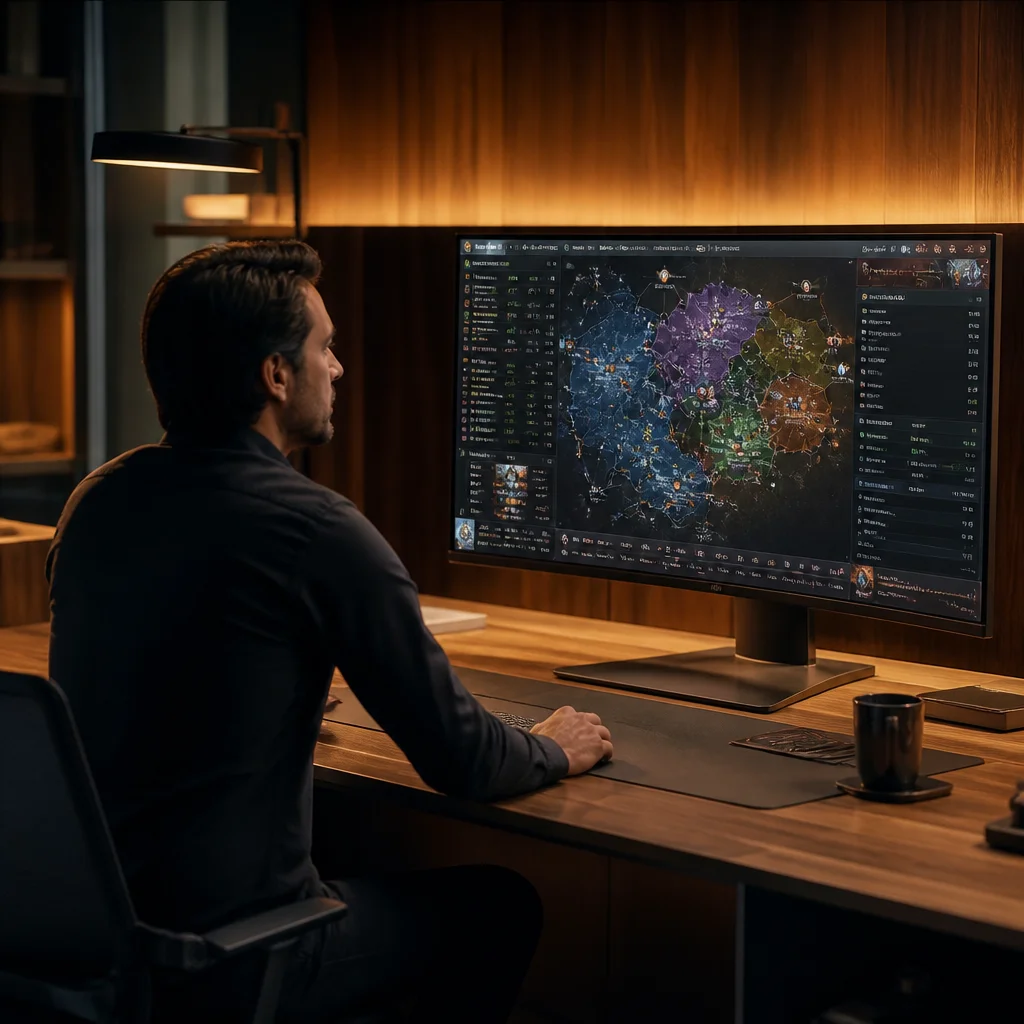
For decades, popular leisure was defined by consumption. You bought a ticket, sat in a dark room, and allowed a pre-packaged narrative to wash over you. The twenty-first century has quietly rewritten that contract. Modern entertainment is no longer a one-way broadcast handed down to a passive audience; it is a dynamic system that demands decisions, sacrifice, trade-offs, and long-term planning. Strategic digital entertainment sits at the absolute center of this shift. By merging the focus of mindful discipline with the engagement of interactive leisure, these experiences challenge users to think critically before acting. Understanding why this hybrid model thrives helps anyone reclaim screen time, transforming mindless scrolling into deliberate play.
The Quiet Shift From Spectating to Deciding
A generation ago, entertainment meant escapism and relaxation. Today, it increasingly signifies active agency. A modern player does not simply watch an empire rise or fall from a distance; they manage scarce resources, calculate volatile risks, and live with the direct consequences of their operational choices. This evolution was not accidental. It was accelerated by high-speed broadband, ultra-responsive hardware, and a cultural hunger for participation. Social feeds trained users to react, comment, and remix media. Interactive titles went a step further, requiring deep commitment. The resulting format feels less like a broadcast and more like a high-stakes craft. The audience is no longer waiting at the end of a distribution pipeline; they are inside the engine room, actively turning the dials.
What Mindful Discipline Actually Means
While the phrase “mindful discipline” sounds austere, in practice it represents a gentle, grounding approach to digital consumption. It simply means maintaining deliberate awareness of your actions while engaging with a platform. It involves establishing a firm session boundary before launching an application, rather than drifting through three hours of unstructured time. It means learning to distinguish between a game that restores your mental clarity and one that subtly degrades your attention span. Applied to interactive leisure, this discipline is never about self-denial; it is about absolute intention. When a user opens a complex strategy simulator for forty focused minutes with a concrete objective and a set stopping point, they are engaging in a practice remarkably similar to meditation. The hardware remains identical, but the quality of human attention is entirely transformed.
Why Strategy Rewards the Disciplined Mind
Strategy games enforce strict accountability by making cause and effect starkly visible. Expand your logistics network too quickly, and your supply lines collapse. Ignore a rising competitor, and they seize the critical resource nodes your economy depends on. Hoard resources instead of reinvesting them, and market shifts will render your reserves obsolete. These rule-bound environments teach resilience because they penalize impatience immediately and measurably. Crucially, they also reward failure. A lost match is never wasted time; it serves as rich, data-dense feedback. Players learn to read a complex board state, practice delayed gratification, and revise a tactical roadmap without emotional friction. In an era dominated by micro-content and endless push notifications, this quiet habit of pausing before executing an action yields immense real-world value.
The Cognitive Payoff: Planning, Patience and Feedback
Cognitive scientists studying interactive media consistently point to specific mental benefits. Systems centered on long-term planning actively train working memory, forcing users to hold multiple parallel futures in their minds simultaneously. They exercise cognitive flexibility, as an optimal strategy from the previous round may fail catastrophically in the current one. Furthermore, they demand rigorous self-regulation, keeping the constant impulse for immediate gratification in check. No honest analysis will claim that playing video games overnight makes someone a genius, but the structural format matters deeply. A platform requiring deep reflection triggers a completely different neurological workout than one engineered purely around raw reflexes. Choosing strategic entertainment is a deliberate exercise in self-awareness—you actively decide which cognitive muscles to train.
Interactive Leisure as a Shared Space
The outdated stereotype of the isolated gamer hunched over a screen in total darkness no longer holds water. Modern interactive leisure is inherently social, often operating through collaborative asynchronous channels. Communities construct exhaustive spreadsheets, debate minute balance adjustments, and author multi-page guides for total strangers. Friend groups plan virtual logistics sessions with the same precision others reserve for dinner parties. Some of the most intellectually stimulating conversations happen entirely offline, when peers compare strategies, analyze catastrophic failures, and debate alternative tactics. This communal layer provides leisure with a rich texture that passive media rarely matches. You are not merely consuming culture; you are actively interpreting and shaping it.
The Business Logic Behind Strategic Entertainment
From an industry standpoint, the meteoric rise of strategic play makes sound commercial sense. Deep, intricate systems foster long-term relationships. A user who invests hundreds of years—or hundreds of hours—mastering a complex title rarely abandons it for a fleeting trend. Studios respond by cultivating live-service ecosystems, releasing seasonal expansions, and rolling out careful balance patches that keep the puzzle fresh. Subscriptions and cosmetic-driven models replace older one-time transactions, shifting the financial focus from opening-weekend hype to multi-year stability. When managed ethically, these titles function much like a weekly chess club or a sophisticated tabletop hobby. The inherent danger arises only when user retention transforms into aggressive psychological manipulation.
Designing for Respect: What Good Systems Do Differently
Truly exceptional strategic entertainment respects the user’s finite time, a value communicated through subtle design choices. Sessions can be paused instantly without negative repercussions. Daily tasks are framed as optional opportunities rather than sources of manufactured guilt. Progress stems from genuine comprehension rather than grinding. Tutorials explain the underlying philosophy of a mechanic rather than merely prompting a button press. User interfaces remain clean and legible, ensuring the challenge stems entirely from the strategic puzzle rather than confusing menus. Most importantly, elite design offers natural stopping points with satisfying closure. Respect is felt as cognitive calm, and that calm is precisely what invites users back willingly.
Screen Time With a Purpose
Many individuals carry a persistent, vague guilt regarding the hours they sink into digital devices. This guilt is rarely productive because it lacks direction. A far better framework involves asking three direct questions. Does this activity leave me feeling mentally energized or depleted? Does it foster genuine connection with people I value? Would I feel comfortable explaining this activity to someone I deeply respect? Strategic digital play consistently clears these hurdles. It is intellectually transparent, easy to schedule, and usually culminates in a tangible sense of problem-solving satisfaction. Leisure does not need to justify itself through industrial productivity; it simply needs to be chosen intentionally rather than absorbed passively.
Risks Worth Naming
Intellectual honesty demands acknowledging the inherent risks of deep digital systems. Intricate strategic loops can easily swallow entire evenings if left unchecked. Competitive ladders can mutate a relaxing hobby into a toxic source of chronic anxiety. Variable reward schedules can mimic the behavioral mechanics of gambling, particularly when real-world currency is integrated. Younger demographics are especially susceptible to these psychological hooks, making household-level guidelines around spending and session caps essential. There is also a subtler hazard: optimization obsession can drain the intrinsic joy out of a hobby. When a game begins to feel like a second job, discipline has failed the human and started serving the algorithm. The antidote is straightforward: take breaks, skip the limited-time events, and play for personal enjoyment.
What Comes Next
The coming decade will likely dissolve the rigid boundary between entertainment software and everyday productivity tools. Strategic planning mechanics are already migrating into fitness trackers, immersive language-learning platforms, and personal finance applications. Interactive leisure is steadily transforming education, professional training environments, and civic planning simulations. Simultaneously, audiences are maturing, quickly identifying shallow design loops and rewarding platforms that treat them as capable, intelligent adults. This trajectory points toward an encouraging future where the most culturally significant entertainment is not the flashiest or fastest, but the one that leaves individuals with concepts worth pondering long after the display turns black.
A Closing Thought on Deliberate Play
Ultimately, the rise of strategic digital entertainment is not a story about processing power or graphics cards; it is a profound story about human attention. People are realizing that modern leisure can be simultaneously restful and intellectually stimulating—that a hobby can sharpen the mind without degrading into a chore. Mindful discipline is not the antithesis of fun; it is the precise element that preserves and deepens enjoyment. Anyone who has completed a well-played tactical session and closed their laptop feeling mentally clear already understands this reality. The future of leisure belongs to those who select their entertainment with the same care they choose their companions: deliberately, and for sound reasons.