Why Tired Brains Take Bigger Risks
Every single day, you execute thousands of microscopic choices. You select what to eat, choose which notification to address first, decide whether to approve a budget line item, and calculate when to leave for an appointment. Each individual decision feels trivial on its own. Yet collectively, they draw from a finite reservoir of cognitive energy. By late afternoon, that psychological fuel tank is frequently running on empty. This state is known as decision fatigue, and it skews how your brain calculates risk far more aggressively than most professionals realize.
Society routinely misinterprets this cognitive depletion as a mere scheduling obstacle. We respond by pouring another cup of coffee, forcing ourselves through one more meeting, and assuming our analytical accuracy remains uncompromised. It does not. The exact same professional who methodically evaluates a complex contract at 9:00 AM can authorize a catastrophic oversight on the exact same document at 5:00 PM. The text of the contract has not changed. The biological evaluator has.
What Decision Fatigue Really Means
Decision fatigue is neither personal laziness nor a failure of willpower. It represents a quantifiable neurological shift in how the mind allocates attention, inhibitory control, and metabolic resources. While psychologists traditionally categorized this as ego depletion—a model continually refined by modern behavioral science—the experiential pattern remains identical for anyone enduring a marathon of corporate alignment meetings. Early decisions receive rigorous cognitive scrutiny. Later decisions inherit whatever residual processing power remains.
The critical insight here is not simply that exhausted individuals make poor choices; it is that they make structurally different choices. They instinctively avoid options demanding deep analytical thought. They default to path-of-least-resistance solutions. Under cognitive strain, they can swing wildly between reckless impulsivity and complete passivity. Risk ceases to be a cold mathematical probability and transforms into an emotional sensation.
The Brain’s Risk Circuitry at a Glance
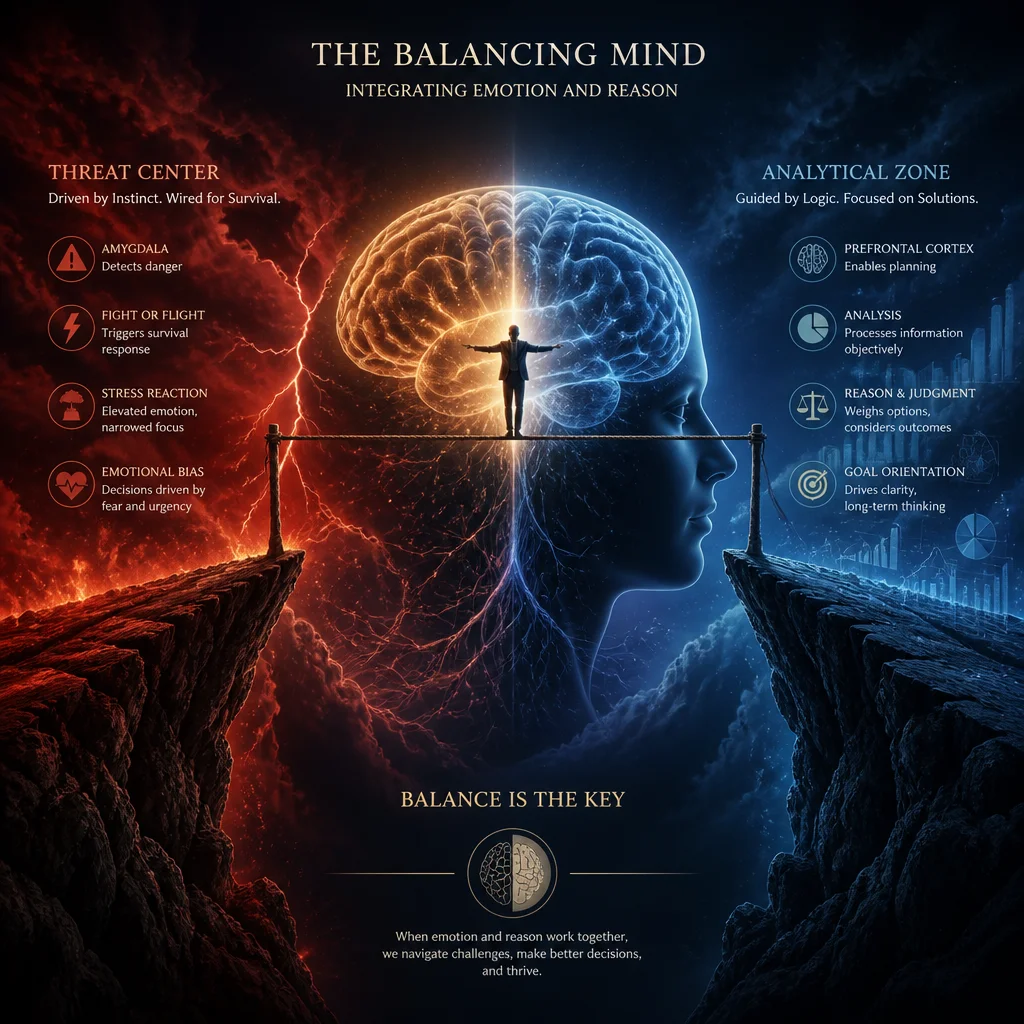
Risk evaluation is not governed by a solitary brain structure. Instead, it emerges from a dynamic, sometimes contentious dialogue between evolutionary systems designed for entirely different survival pressures. Recognizing this internal interplay clarifies why your risk appetite after eight hours of uninterrupted sleep diverges sharply from your risk tolerance at 6:00 PM on a grueling Thursday.
- The prefrontal cortex (PFC) manages executive functions, long-term planning, probability weighting, and holding competing hypotheses in working memory. It is computationally powerful, remarkably slow, and metabolically expensive to operate.
- The amygdala functions as an aggressive threat-detection radar, scanning the environment and reacting instantaneously. It flags danger long before conscious logic can articulate the threat.
- The insula continuously monitors internal somatic signals, translating physiological shifts into that subtle sense of unease or confidence we casually label a gut feeling.
- The striatum and dopaminergic pathways assign subjective value to prospective outcomes, driving behavioral momentum toward anticipated rewards and away from potential punishments.
When you are fully rested, these neurological systems operate in a coordinated ecosystem. A robust prefrontal cortex can successfully override a sudden spike of fear or an irrational flash of greed. When you are metabolically depleted, however, the internal balance shifts dramatically toward faster, evolutionarily older circuits. Processing speed vanquishes analytical accuracy—and absolute accuracy is the non-negotiable prerequisite of sound risk management.
Why Fatigue Makes Risk Look Different
Exhaustion does not merely inflate the psychological weight of risk; it frequently shrinks it in paradoxical ways. Controlled studies on acute sleep deprivation demonstrate that tired subjects become significantly more willing to accept high-stakes gambles with volatile payoffs, while simultaneously overreacting to minor, non-threatening stimuli. This produces a volatile psychological cocktail of unwarranted bravado and hyper-vigilant anxiety that bears zero relation to actual statistical probabilities.
The Cognitive Shortcut Trap
A depleted brain substitutes rigorous calculation with crude mental heuristics. Instead of auditing whether a strategic move is objectively sound, the mind evaluates whether the choice is frictionless. Instead of comparing three viable options, it seizes the first alternative that appears socially or mentally acceptable. These shortcuts are systematic, heavily biased toward minimizing immediate mental exertion even when that choice exponentially increases long-term exposure to risk.
Emotion as Miscalibrated Data
Emotions are not extraneous noise interfering with rational thought; they are compressed data packets designed to guide behavior. Anxiety signals that something demands immediate attention; enthusiasm indicates an imminent reward. The structural failure occurs when fatigue distorts the fidelity of this signal. A mild professional setback registers as an existential emergency. A genuine warning sign is summarily dismissed simply because the executive system lacks the energy required to formulate a response.
How the Brain Prices Uncertainty
Ambiguity carries a heavy emotional tax, and the exhausted brain actively reorganizes its priorities to avoid paying it. Confronted with incomplete data, the mind rapidly patches informational gaps with whatever catastrophic narrative is most easily accessible. If your morning news feed featured economic turbulence, missing project details suddenly assume a catastrophic hue. This explains why executive risk assessments fluctuate wildly on negligible empirical evidence.
Behavioral research into ambiguity aversion confirms that humans overwhelmingly prefer a known 50% probability to an entirely unknown probability, even when the expected mathematical value is identical. Under the influence of decision fatigue, this preference solidifies into rigidity. Unknown outcomes begin to look overwhelmingly negative by default, driving executives toward overly cautious maneuvers disguised as prudence. Conversely, during cognitive fatigue spikes, the exact same tired brain can flip into reckless speculation simply to terminate the agonizing discomfort of not knowing.
Regardless of the behavioral direction, the underlying mechanics remain consistent. The brain is no longer calculating expected values; it is frantically managing emotional distress on an empty metabolic budget.
Emotional Resilience: The Missing Variable
Two professionals can confront an identical high-stakes crisis after identical sleep cycles and arrive at radically divergent decisions. The differentiator is emotional resilience: the capacity to experience intense affective states without allowing them to hijack cognitive control. True resilience is neither stoic toughness nor the absence of emotion; it is the neurological buffer that grants an individual sufficient time between stimulus and response to think.
Resilient individuals experience fear, frustration, and pressure just like anyone else. Their competitive advantage lies in recovery velocity. They return to their neurochemical baseline faster, ensuring their risk appraisals remain untainted by the residue of a hostile negotiation or a deteriorating market report.
- They explicitly label their emotional state rather than acting out the impulse reflexively.
- They ruthlessly decouple the objective magnitude of a problem from the subjective intensity of their physiological reaction to it.
- They engineer micro-recoveries directly into their daily schedules rather than waiting for an annual vacation.
- They treat historical missteps as empirical data points rather than permanent indictments of their professional competence.
Furthermore, resilience possesses a distinct interpersonal dimension. Professionals who routinely externalize complex choices with a trusted peer recover from stress exponentially faster and commit fewer impulsive errors. A secondary perspective does not merely contribute fresh data points; it lowers the overall emotional temperature of the room, allowing higher-order cortical analysis to come back online.
The Cost of Unresolved Decisions
Open cognitive loops are remarkably expensive assets to maintain. An unresolved dilemma continues to consume background processing bandwidth, draining mental RAM even when you are not consciously focusing on the problem. Accumulate dozens of these stagnant loops, and a routine workday transforms into an exhausting endurance test, ultimately manifesting as flawed risk assessments on decisions that genuinely matter.
Closing loops imperfectly and quickly is almost always superior to leaving them open in pursuit of an elusive perfection. A pragmatic, “good enough” choice executed today preserves vital cognitive bandwidth for the high-impact decision landing on your desk tomorrow morning. Perfectionism applied to low-stakes operational choices is one of the most reliable catalysts for premature decision fatigue.
Signs You Are Deciding on Empty
Decision fatigue rarely issues a formal warning. Instead, it leaks out through subtle behavioral markers that are easily rationalized individually but undeniable in aggregate.
- You find yourself rereading the same paragraph three times without retaining the syntax.
- You default to the path of least resistance solely to terminate an ongoing discussion.
- You experience disproportionate irritation toward routine, low-stakes administrative requests.
- You actively procrastinate on executing a decision for which you already possess all necessary parameters.
- You experience intense physiological cravings for simple carbohydrates, caffeine, or screen escapism after a sustained cognitive sprint.
- You repeatedly second-guess a strategic commitment about which you felt entirely confident an hour prior.
None of these symptoms indicate professional incompetence. They are empirical indicators that your daily decision budget is depleted and your nervous system is desperately seeking a lower-energy operational mode.
The Physiology Behind the Fog
The psychological sensation of mental burnout has a direct physiological counterpart. Prolonged cognitive concentration triggers sustained cortisol elevation, depletes local neural glucose supplies, and hyper-activates the brain’s threat-detection hubs. Chronic sleep deprivation compounds this cellular stress by physically degrading the white-matter connectivity between the prefrontal cortex and the amygdala—explaining precisely why a single fragmented night transforms an ordinary operational glitch into an emotional crisis.
Circulating blood sugar fluctuations, systemic dehydration, and prolonged sedentary hours compound the neurological drag. These physiological inputs matter immensely because they are entirely within your locus of control. While you cannot always dictate corporate workloads or volatile market conditions, you can aggressively manage the underlying biology that dictates your personal risk perception.
Why Teams Catch It Too
Decision fatigue is not strictly an isolated, individual phenomenon. Marathon meetings, overloaded agendas, and convoluted corporate governance structures generate identical systemic degradation at the organizational level. Fatigued teams reach premature consensus too rapidly, reflexively defer to the loudest voice in the room, or avoid difficult strategic pivots entirely. If you manage people, the strict timing, structuring, and duration of your meeting agendas represent vital risk-management interventions in their own right.
Practical Ways to Protect Your Judgment
- Schedule hard decisions early. Reserve the first three hours of your operational day—when your prefrontal cortex is metabolically pristine and heuristic shortcuts are at a minimum—for high-consequences choices.
- Reduce daily micro-choices. Systematically automate routine variables like nutritional choices, wardrobe selections, recurring meeting schedules, and standardized approvals. Every trivial choice eliminated preserves capacity for strategic pivots.
- Implement algorithmic decision rules. Pre-commit to explicit threshold criteria in advance. If a vendor clears a pre-set metric across three dimensions, you execute the contract. Pre-written rules replace high-pressure, in-the-moment emotional evaluation.
- Build structural pauses into high-stakes moments. A simple ten-minute walk or a night of restorative sleep reliably shifts risk appraisal far more effectively than an extra hour of frantic, exhausted analysis.
- Treat sleep as a core operational input. Sleep is the single most powerful regulatory lever governing emotional stability and accurate risk calibration. Treat an acute sleep deficit as a mandatory trigger to postpone major commitments, never as a badge of honor.
- Externalize fear versus fact. Verbally or in writing, separate catastrophic emotions from verifiable empirical threats. Articulating the emotion disrupts its autonomic grip and forces objective reality testing.
Designing a Day That Respects Your Brain
The most reliable strategy for upgrading organizational risk judgment is not trying harder through sheer grit; it is architecting an environment where stellar judgment demands less metabolic friction. Batch your low-level administrative decisions into dedicated time blocks. Maintain a strict, pre-approved menu of standard operating procedures. Implement mandatory cognitive breaks before exhaustion sets in, rather than scrambling to recover afterward. Conclude your workday with a concise, written ledger detailing what you decided and why, ensuring tomorrow’s cognitive engine does not have to restart the analytical loop on depleted fuel.
It is equally critical to decouple the phase of deciding from the phase of executing. When your morning is dedicated exclusively to high-level evaluation and your afternoon is reserved for mechanical execution, your neural processing architecture receives vital micro-resets. When both functions overlap constantly, strategic clarity dissolves into a perpetual fog of half-baked choices and unverified assumptions.
A Final Thought on Steady Judgment
Risk is never a fixed, immutable property of the external world. It is a dynamic simulation constructed by your neural architecture in real-time, utilizing whatever biological resources remain accessible at that precise hour. This fundamental reality explains why an identical business proposition can appear brilliantly opportunistic at dawn and terrifyingly hazardous by midnight. Emotional resilience and decision fatigue are not abstract psychological luxuries. They are the foundational operating conditions under which every vital choice of your career is made. Master those biological conditions, and the complex risk matrix before you will finally reflect reality as it truly is.